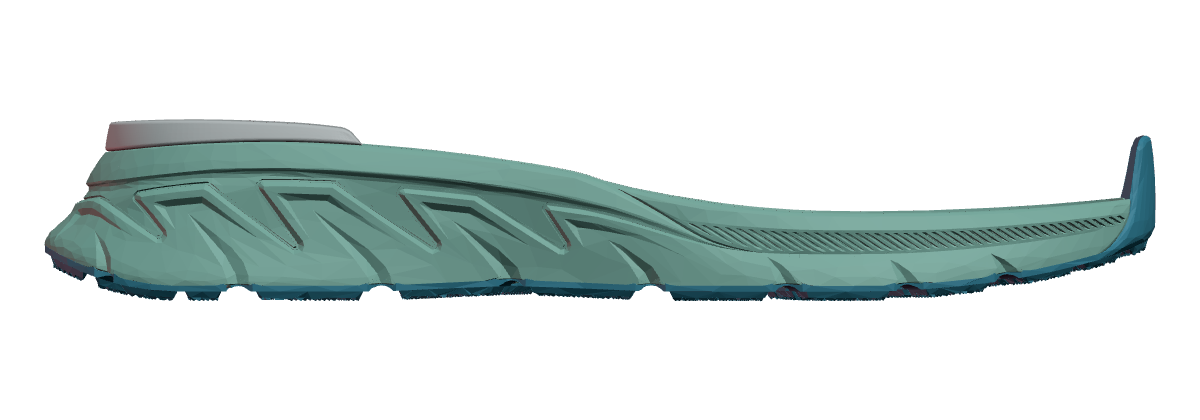
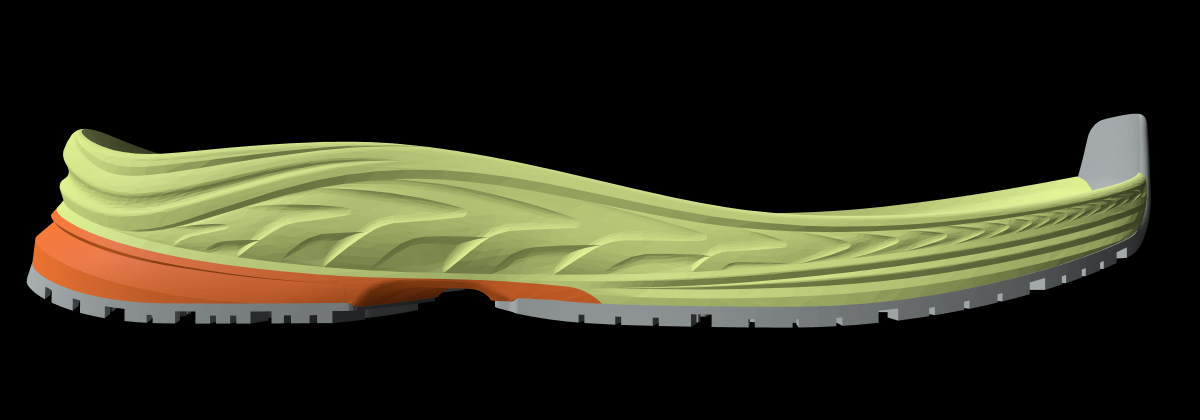
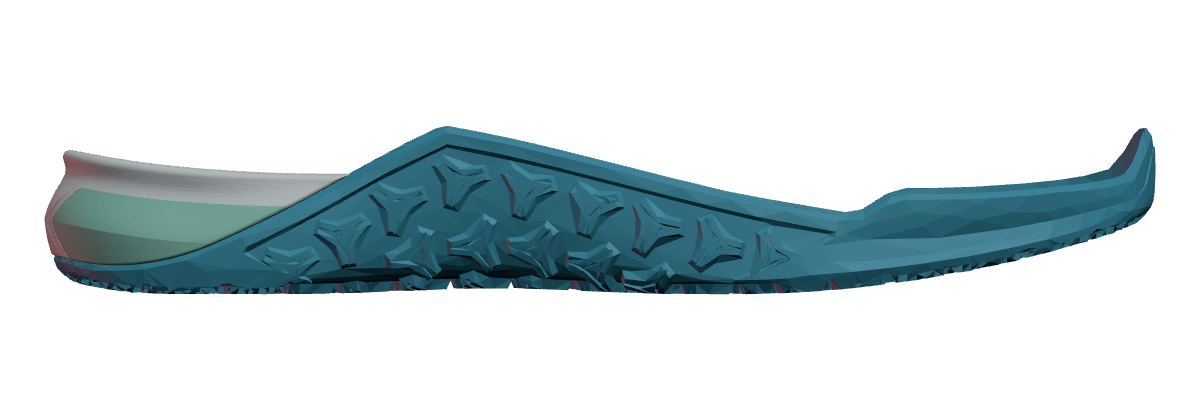
What TPU is
TPU is a block copolymer with hard and soft segments. The hard segments give strength and abrasion resistance; the soft segments give elasticity. Outsole grades are typically much harder than rubber outsoles, from the high Shore A range up into Shore D for rigid soleplates. Because TPU is thermoplastic, it can be remelted and recycled.
How TPU outsoles are made
- Drying — TPU pellets are dried carefully; moisture causes defects during molding.
- Injection molding — Melted TPU is injected into a precision mold. Thin sections, sharp edges, studs and textures all reproduce cleanly.
- Multi-shot molding — Two or more hardnesses or colors can be molded into one part, for example a stiff plate with softer flex zones.
- Cooling and finishing — Parts cool quickly in the mold and need little trimming.
TPU can also be direct-injected onto the upper, or combined with a PU midsole in dual-density work footwear.
Grip: 6 / 8, High
On soft surfaces such as grass, TPU grips through geometry: studs and blades penetrate the ground and give mechanical traction. On hard, smooth and wet surfaces, harder TPU grades can be slippery, because the surface does not conform to the floor the way soft rubber does. Softer grades, textures and rubber inserts improve grip where slip resistance to EN ISO 13287 is required.
Flex: 6 / 8, High
TPU is stiff in thick sections and flexible in thin ones. Designers use that to put stiffness exactly where it is needed, such as a rigid heel counter area and a flexible forefoot zone in one soleplate. TPU also keeps its flex better in the cold than many rubbers and PVC.
Abrasion: 8 / 8, Max
TPU is one of the most abrasion-resistant outsole materials, with very low volume loss in ISO 4649 testing. It also resists cuts, tears and many oils and fuels. That combination is why TPU is used for studs, cleats and the high-wear parts of work and safety outsoles.
Where TPU outsoles are used
- Football boots — soleplates, studs and blades for firm and artificial grass.
- Golf shoes — spikeless traction elements and cleat receptacles.
- Safety and work footwear — wear- and oil-resistant outsoles, often over a PU midsole.
- Technical and outdoor footwear — toe bumpers, heel caps and structural outsole parts.
Designing with TPU outsoles
Use TPU where the outsole needs structure, precise geometry or exceptional wear life.
- Use rubber where grip on hard, wet surfaces is the main requirement.
- Vary thickness and add multi-shot flex zones to control where the plate bends.
- Add rubber pods or softer TPU where the outsole meets hard, smooth floors.
- Test slip resistance early for safety footwear; hard TPU can struggle on wet tiles.
- Dry materials thoroughly and control mold temperature to avoid weak, brittle parts.