Ask most people what makes a sole grippy and they will say deep tread. The research says something else: on a wet floor, which way the grooves point matters more than how deep or wide they are.
The experiment
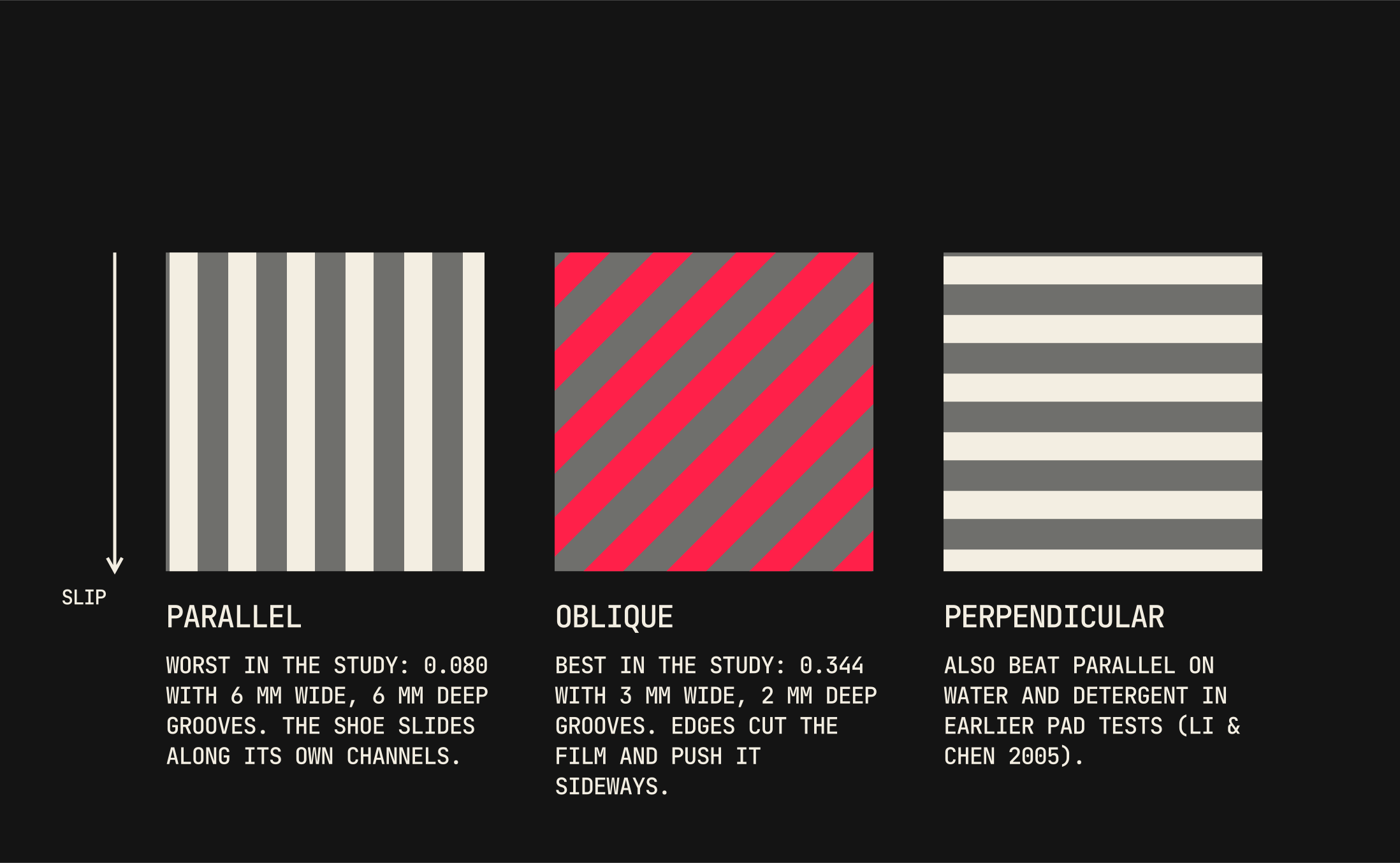
Blanchette and Powers built 27 outsoles that differed in only three ways: groove orientation (parallel to the slip, oblique, or perpendicular), groove width (3, 6 or 9 mm) and groove depth (2, 4 or 6 mm). They tested each on a wet surface with a whole-shoe slip tester (Blanchette & Powers, 2015).
Friction ranged from 0.080 to 0.344, a fourfold spread from geometry alone. Orientation explained 81 percent of that variance.
- Best: oblique grooves, 3 mm wide, 2 mm deep.
- Worst: grooves parallel to the slip, 6 mm wide, 6 mm deep.
The deepest, widest tread in the study was the worst performer.
Why direction wins
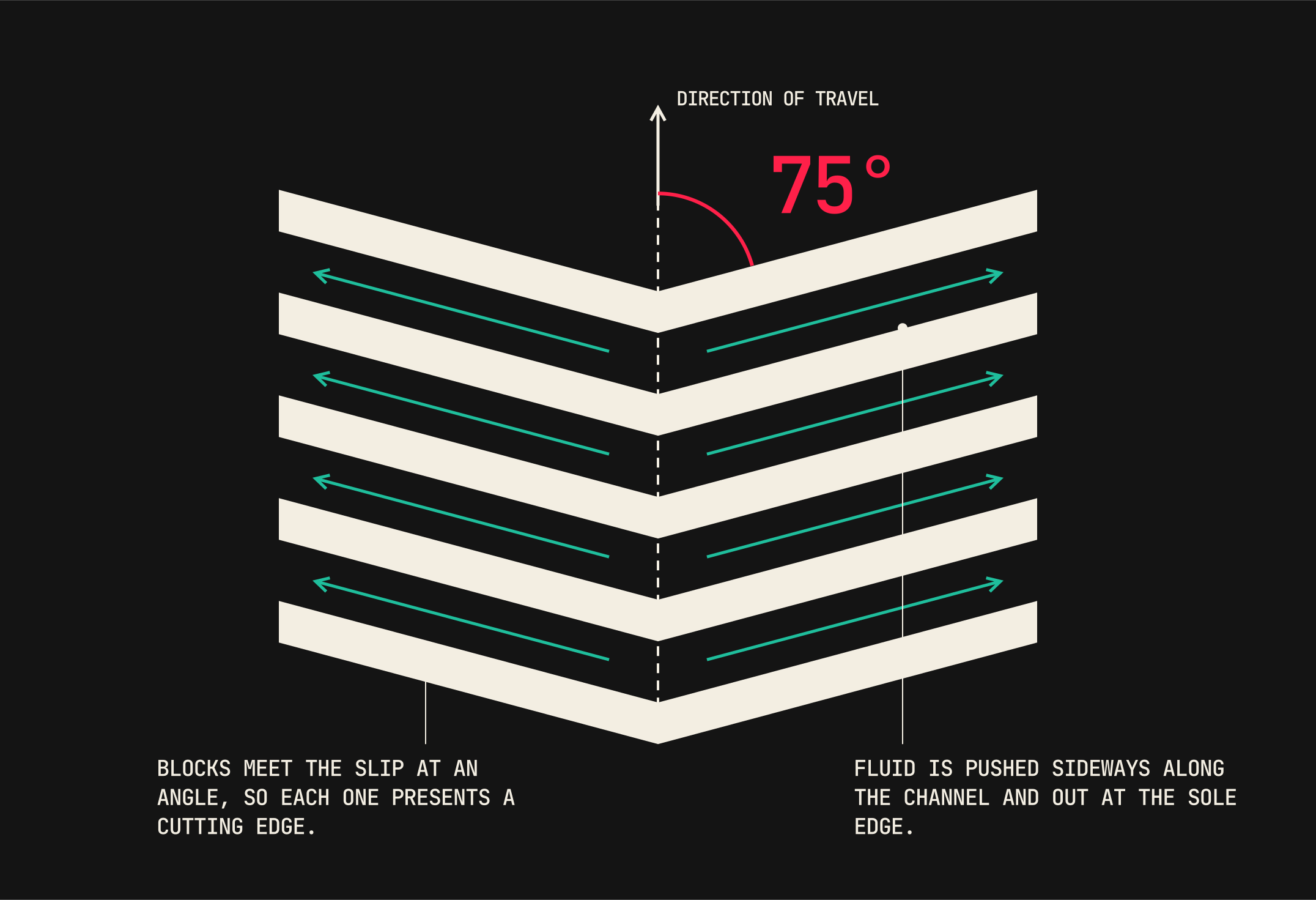
A groove that runs along the slip direction gives the fluid no reason to leave; the shoe slides along its own channel. A groove set across or at an angle presents an edge to the fluid and pushes it sideways, out from under the shoe.
Why deeper is not always better
Depth helps drainage up to a point. One study found each extra millimetre of groove depth, from 1 to 5 mm, added 0.018 to 0.108 friction on wet and detergent floors (Li, Wu & Lin, 2006). But past a certain height, friction pulls on the block face and bends it. A tall or soft block tilts, its contact patch shrinks and its leading edge lifts. A short block stays flat on the floor.
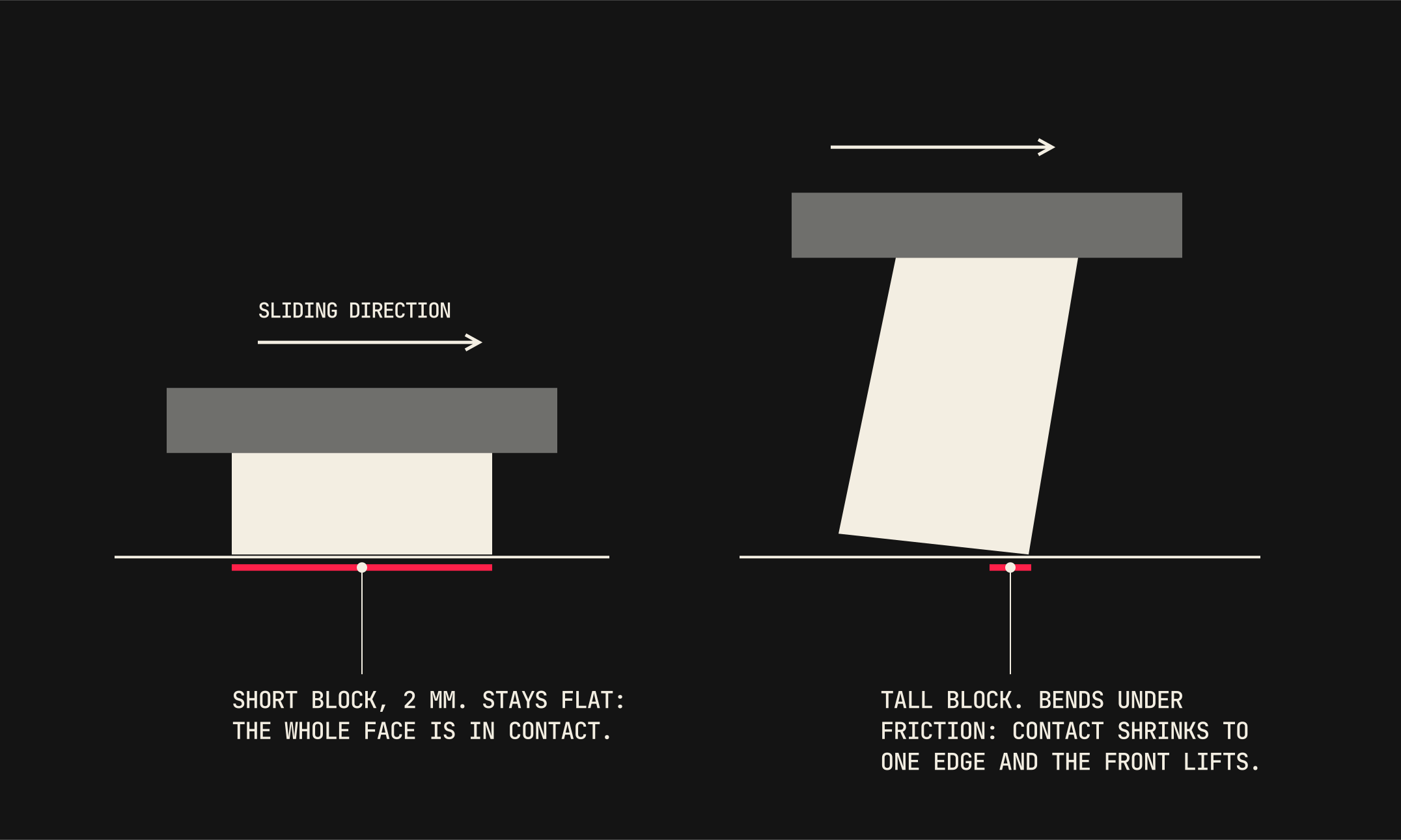
So depth and compound have to be chosen together: the softer the rubber, the shorter the lug.
The angle
A 2024 study from IIT Delhi tested 24 oblique designs and found channels at 75 and 105 degrees to the direction of travel gave the best traction, dry and wet (Gupta et al., 2024). Earlier work found the same pattern: perpendicular and 45-degree grooves beat parallel ones on water and detergent (Li & Chen, 2005).
Where it gets complicated
One block study under thick glycerol found the opposite: blocks aligned with the slip did best. The likely reason is that a viscous film cannot be drained in time, so block stiffness and contact area take over from drainage.
So the contaminant decides. Thin liquids such as water reward angled channels. Thick ones such as oil reward stiff blocks, contact area and sharp edges.
What we take from it
- No channel parallel to travel in the heel.
- Oblique channels that open at the sole edge.
- Lugs kept short enough to stay stiff.
- Every pattern tested on both a thin and a thick contaminant.
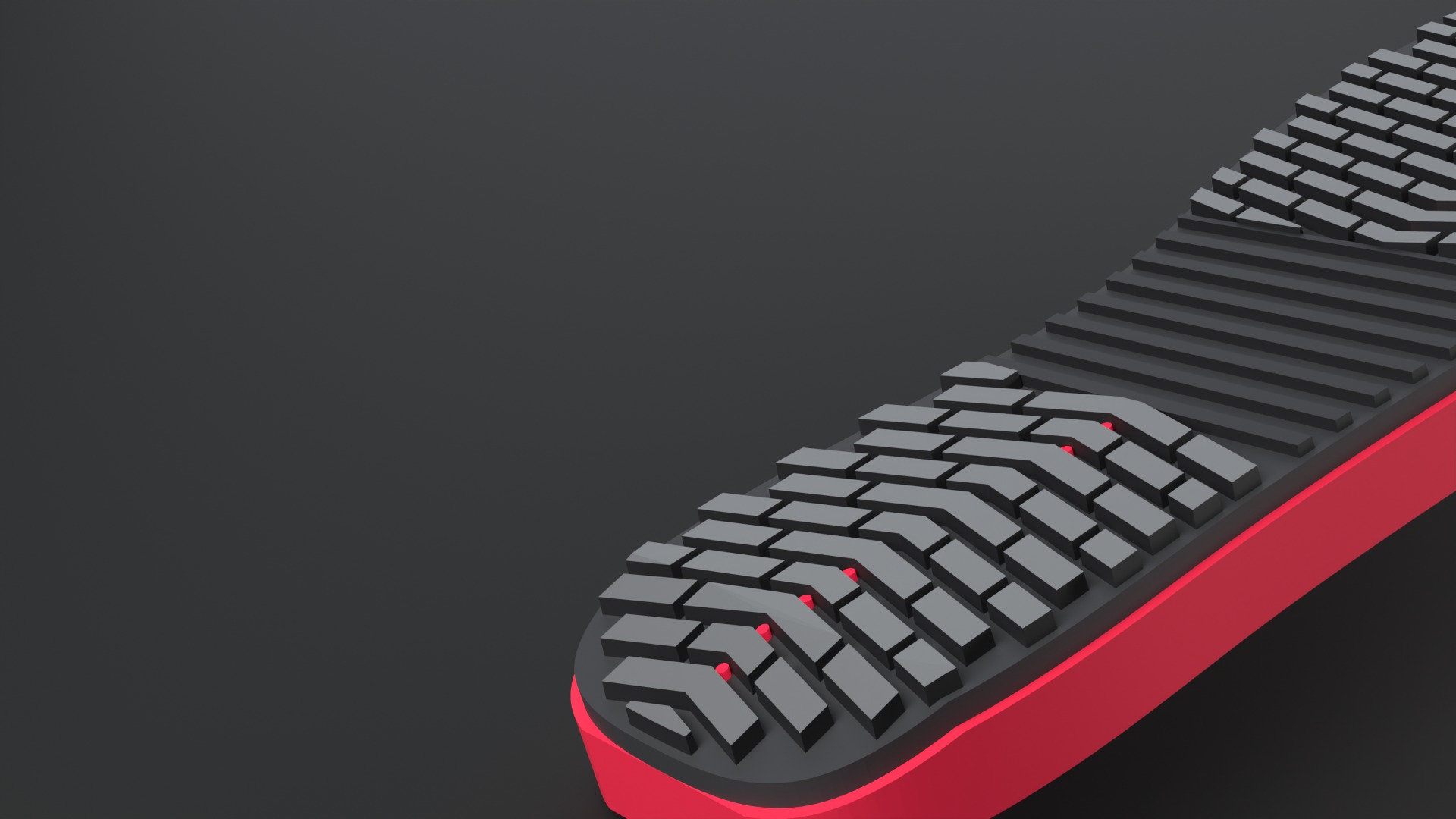
ALCMY Systems engineers outsoles from the research up. Talk to us about your next sole.
Sources
- Blanchette & Powers 2015, The influence of footwear tread groove parameters on available friction, Applied Ergonomics
- Li, Wu & Lin 2006, The effect of shoe sole tread groove depth on the friction coefficient, Applied Ergonomics
- Gupta et al. 2024, Effect of oblique outsole tread orientation on slip performance
- Li & Chen 2005, Effects of tread groove orientation and width of the footwear pads on measured friction coefficients, Safety Science