A sole can lose wet grip while its tread still looks deep. The cause is often too small to see: the leading edge of each block has gone round.
A tenth of a millimetre
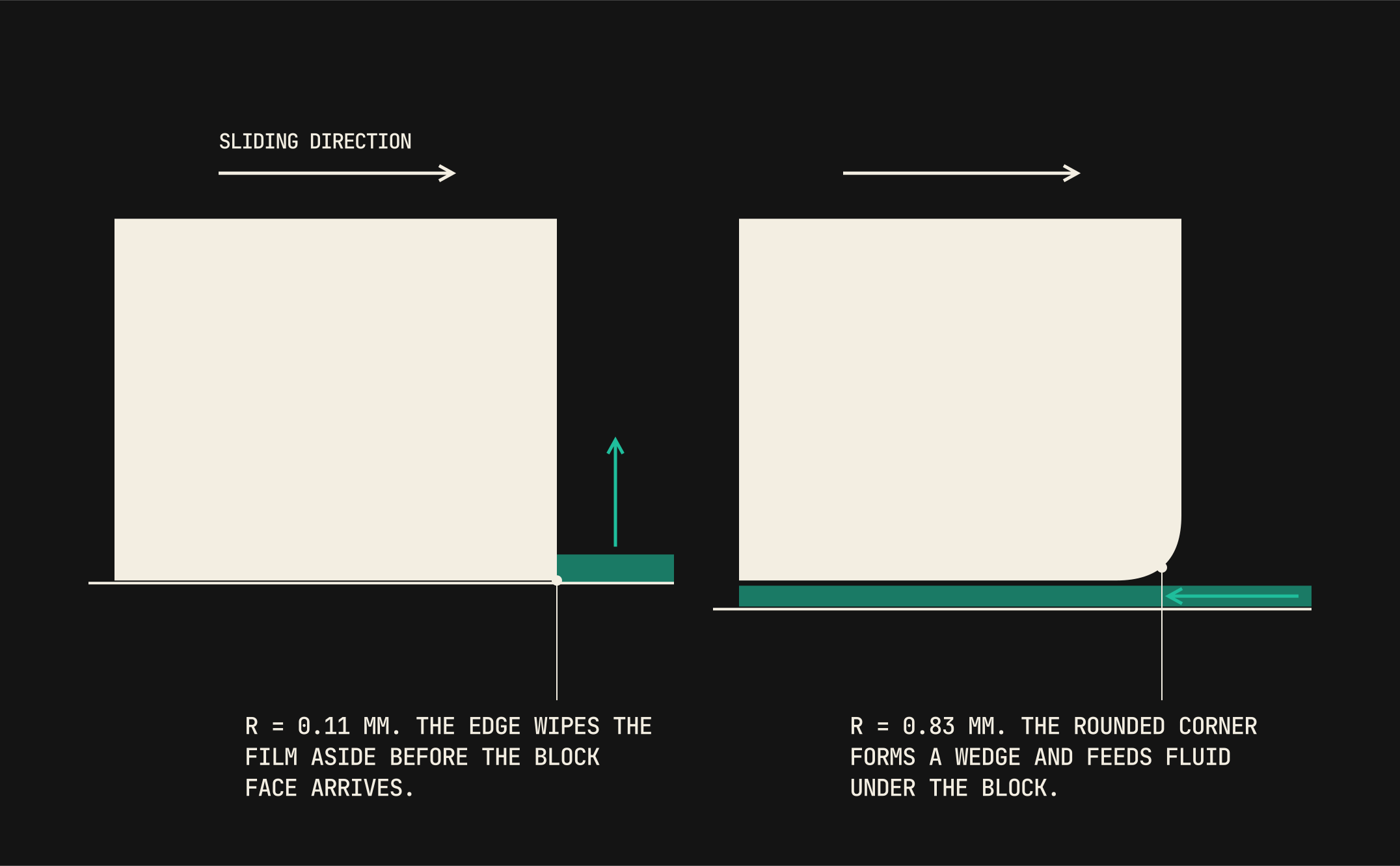
A team at Tohoku University slid rubber blocks across glass under glycerol, changing one thing: the radius of the block's front corner. Blocks with a 0.11 mm corner gave higher friction than blocks with a 0.83 mm corner (Ishizako et al., 2022). A follow-up confirmed the trend: the smaller the radius, the higher the lubricated friction (Ishizako et al., 2023).
Dry, the result reversed. Rounder corners gripped better.
The edge is a wiper
A sharp leading edge works like a squeegee. It meets the fluid film at a steep angle and scrapes it aside before the block face arrives. A rounded edge forms a wedge instead, and a wedge is how fluid gets under a surface and lifts it. It is the same reason a worn wiper blade smears.
Why this is a wear story
Edges do not stay sharp. Walking chamfers them, and modelling work at the University of Sheffield links that chamfering to weaker fluid wiping. So wet grip can fade well before tread depth says the sole is finished.
What comes next
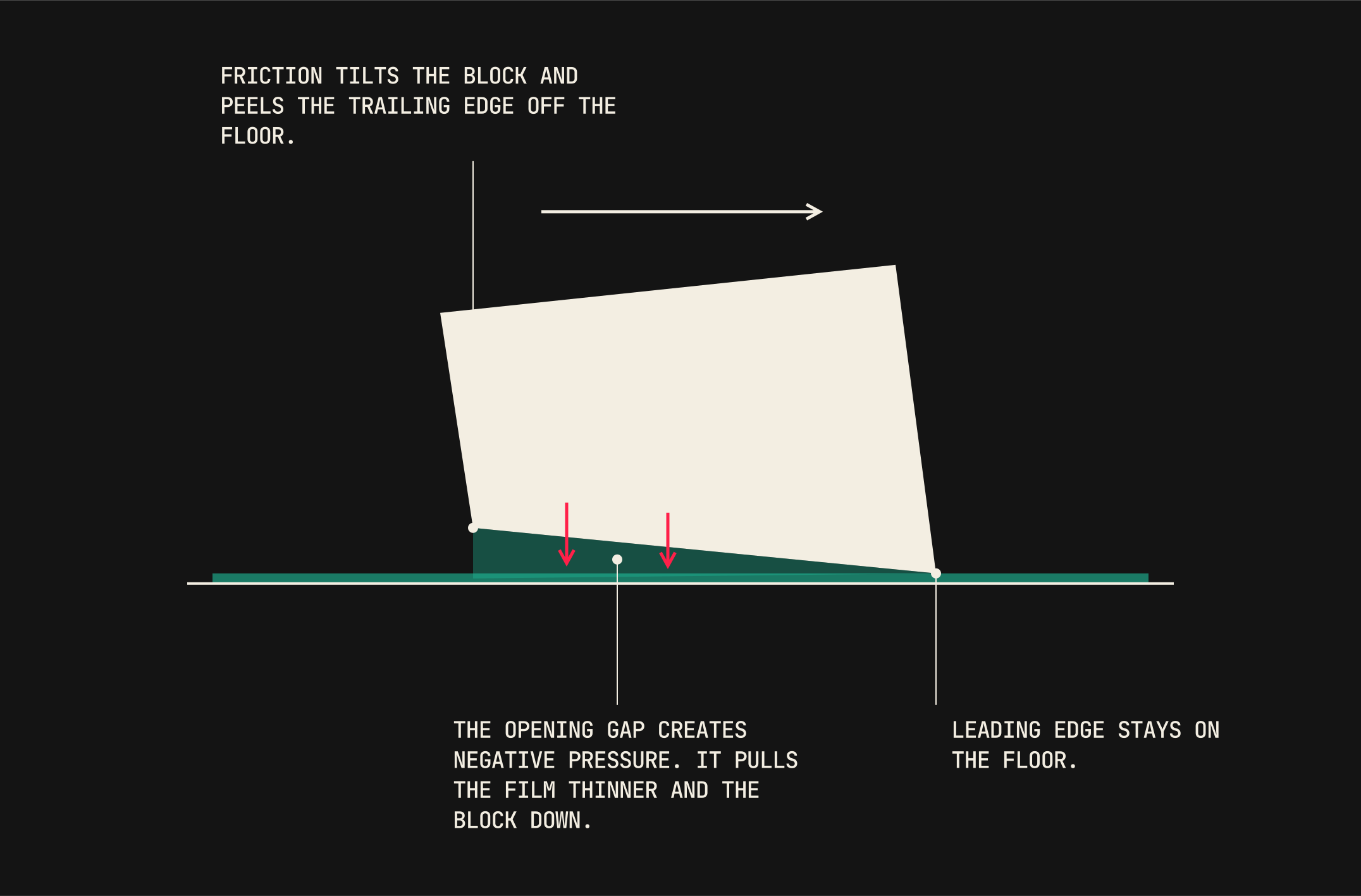
The same Tohoku group has since shown something stranger. When a block slides, friction tilts it and peels its trailing edge off the floor. The opening gap creates suction that thins the film. Treads with inclined grooves built to use this effect reached up to four times the kinetic friction under glycerol (Ishizako et al., 2024, and a 2025 follow-up).
These are lab blocks, not whole shoes. But the direction is clear: the next gains in wet grip will come from controlling fluid at the edge, not from deeper tread.
The engineering problem
Wet grip wants edge radii near 0.1 mm. Rubber moulding guidance prefers radii above 1 mm, for tear strength and clean release. The Tohoku blocks were laser cut.
That gap between what the science asks for and what a mould delivers is where outsole development gets interesting. It is a question of compound, tooling and wear together, and it is one we are working on.
ALCMY Systems engineers outsoles from the research up. Talk to us about your next sole.