The carbon plate gets the headlines. The research points somewhere else: most of what makes a modern racing shoe fast is the foam.
Where the 4% came from
In 2018, researchers in Colorado had 18 high-level runners test the Nike Vaporfly prototype against two leading marathon shoes of the time. It lowered the energy cost of running by about 4% on average, and every one of the 18 runners used less energy in it (Hoogkamer et al., 2018). The shoe combined three things at once: a new PEBA foam, a curved carbon plate and a thick, rockered sole.
Cutting the plate changed little
To isolate the plate, the same group cut six slots across the carbon plate in the forefoot of a Vaporfly, removing much of its stiffness. Running economy was on average only 0.55% worse in the cut shoe, and the difference was not significant (Healey & Hoogkamer, 2022). The authors conclude the savings come from the interaction of foam, geometry and plate, not from bending stiffness alone.
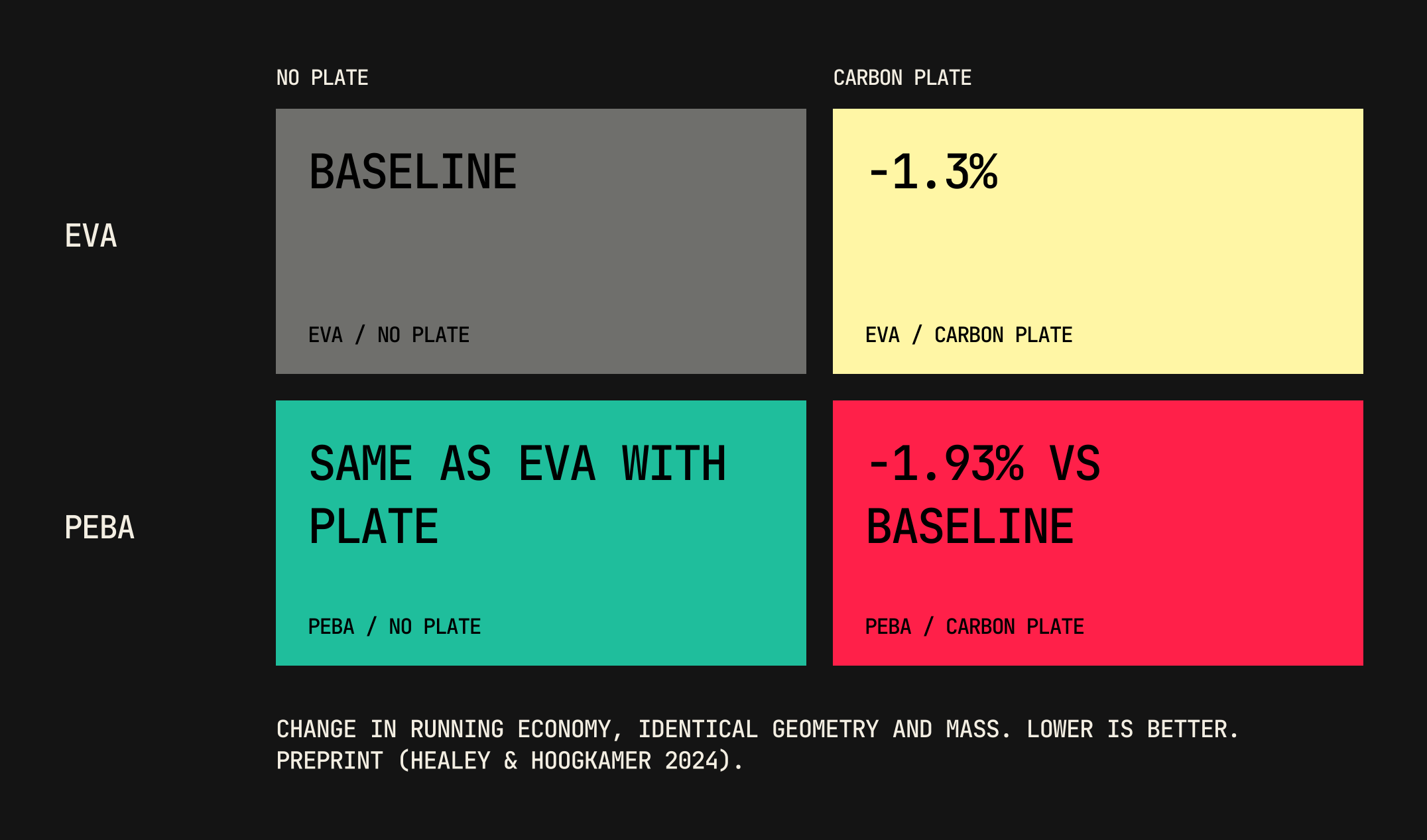
A newer study, still a preprint, built four shoes with identical geometry and weight: EVA or PEBA foam, each with and without a plate. The plate helped the EVA shoe by 1.3% but added little to the PEBA shoe. The PEBA shoe without a plate matched the EVA shoe with one (Healey & Hoogkamer, 2024).
Resilience, not just softness
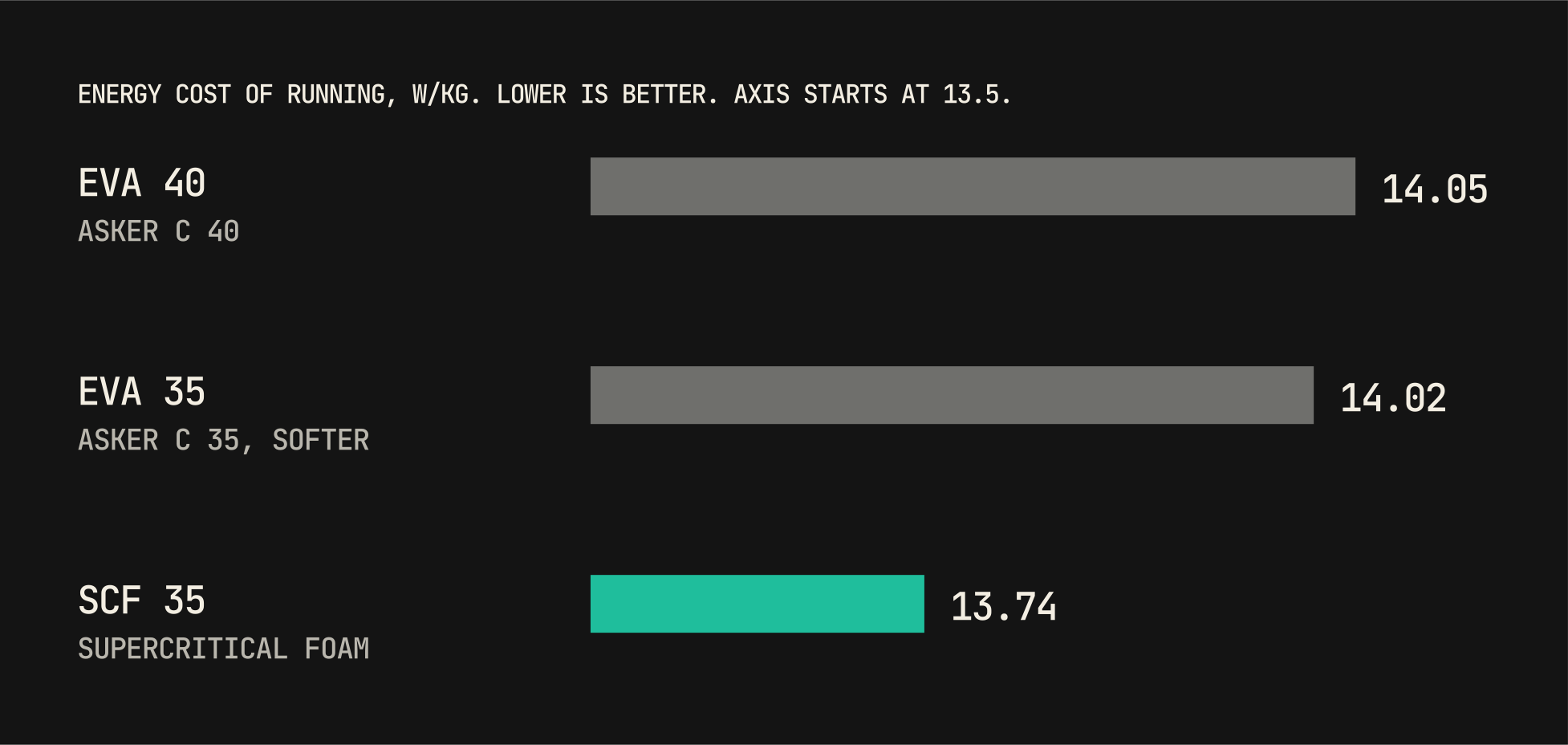
Softness alone is not the answer either. In a 2026 study with 17 female runners, two EVA shoes of different hardness cost the same energy, 14.05 and 14.02 W/kg. A supercritical foam of the same hardness as the softer EVA cost 13.74 W/kg, about 2% less (Rodrigo-Carranza et al., 2026). What changed was how little energy the foam wasted, not how soft it was.
Not every plated shoe works
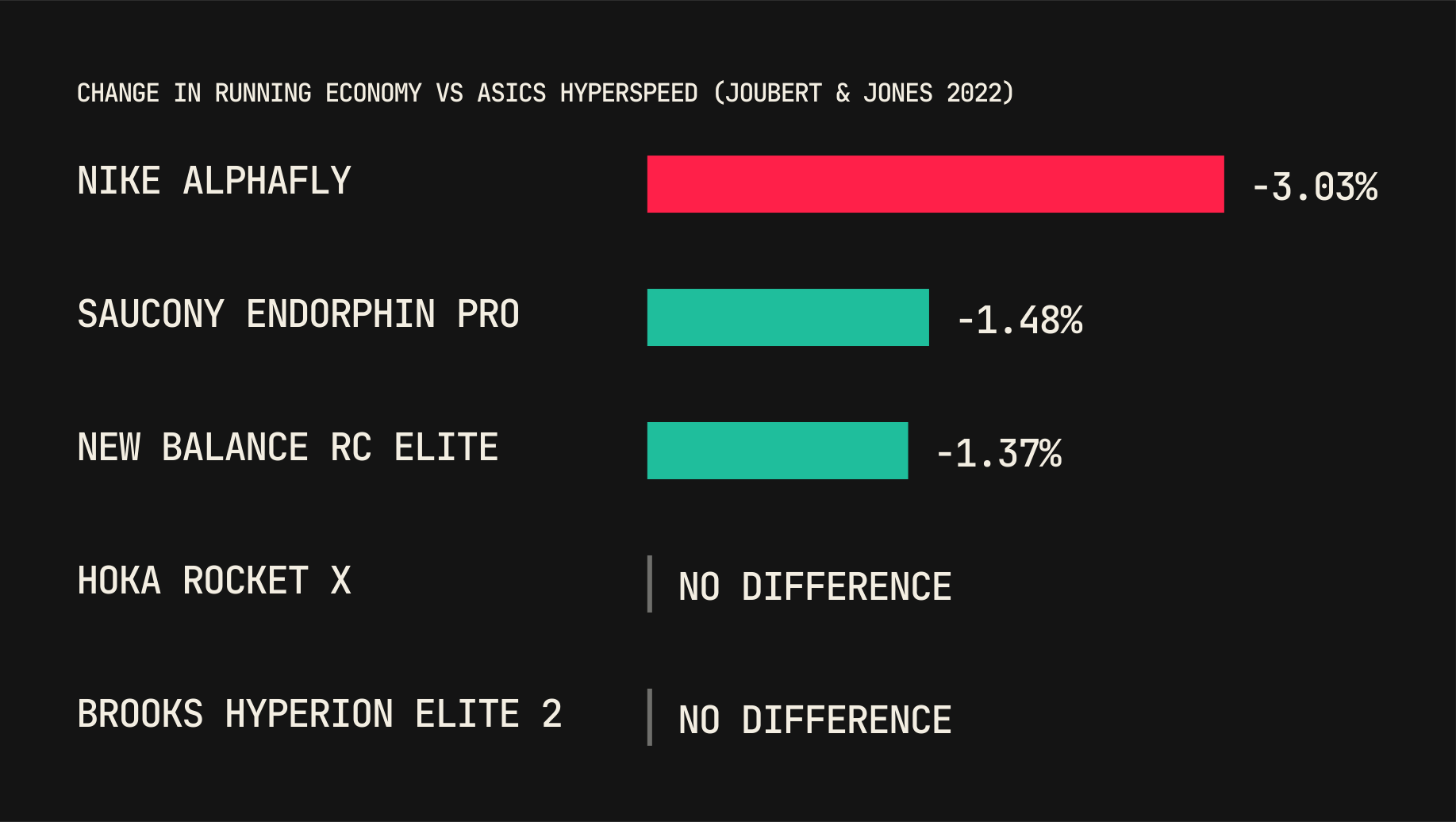
When 12 trained runners tested carbon-plated racers against a conventional racing shoe, the savings ranged from about 3% down to nothing (Joubert & Jones, 2022). Two of the plated shoes were no better than the conventional racer. A plate and thick foam do not make a super shoe on their own.
Weight still counts
Adding mass to the foot costs about 1% more oxygen for every 100 g per foot (Franz, Wierzbinski & Kram, 2012). A lighter foam is a performance feature in its own right.
What we take from it
- Start with the foam. Resilience at running loads and speeds is the main lever.
- Use the plate to support a weaker foam, not as a substitute for a good one.
- Count every gram. Saving 50 g per shoe is worth roughly what some plates deliver.
- Test the whole system on runners. Formulation and geometry decide the result, not the plate label.
ALCMY Systems engineers midsoles and outsoles from the research up. Talk to us about your next sole.
Sources
- Hoogkamer et al. 2018, Sports Medicine 48
- Healey & Hoogkamer 2022, Longitudinal bending stiffness does not affect running economy in Nike Vaporfly shoes, Journal of Sport and Health Science 11
- Healey & Hoogkamer 2024, bioRxiv preprint
- Rodrigo-Carranza et al. 2026, International Journal of Sports Physiology and Performance 21(6)
- Joubert & Jones 2022, Footwear Science 14
- Franz, Wierzbinski & Kram 2012, Medicine & Science in Sports & Exercise 44