The foams that make racing shoes fast are soft, light and springy. Those same properties bring two costs that designers need to manage: sideways stability and durability.
Soft vertically, soft sideways
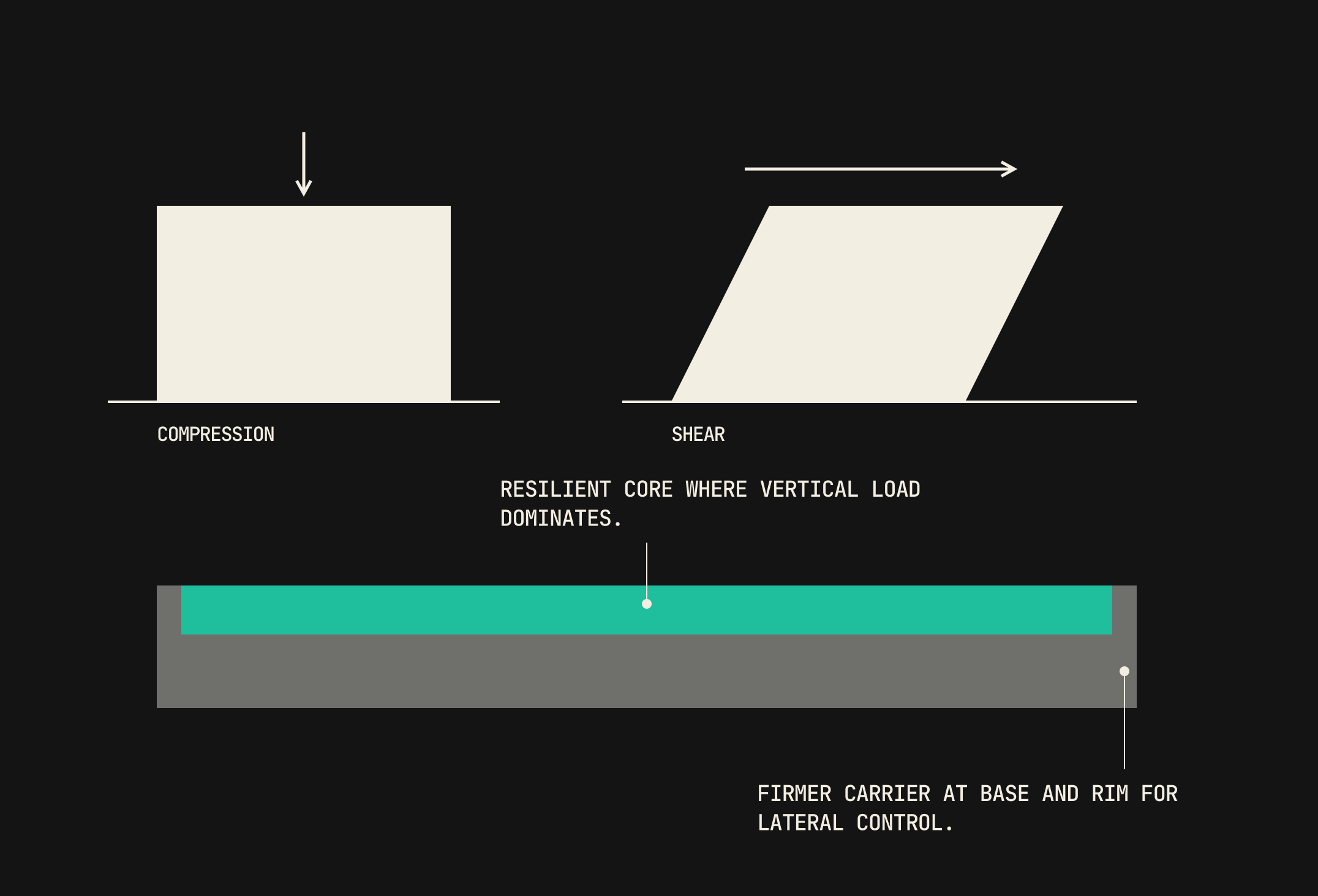
A running foot does not only push straight down. At landing and push-off, the midsole is also sheared sideways and front to back. Foams are tested almost entirely in compression, so this side of their behaviour is easy to miss.
A preprint from Stanford tested foam samples cut from ASICS racing shoes in both directions. The foams returned 85 to 90% of the energy in compression, but only about 74 to 76% in shear (McCulloch, Delp & Kuhl, 2026). The study is not yet peer-reviewed, but it matches what runners report: highly resilient foams can feel vague in corners and on uneven ground.
The usual design answer is to split the job. A resilient core sits where vertical load dominates, and a firmer carrier or sidewall controls lateral movement at the base and rim.
Taller stacks magnify the effect
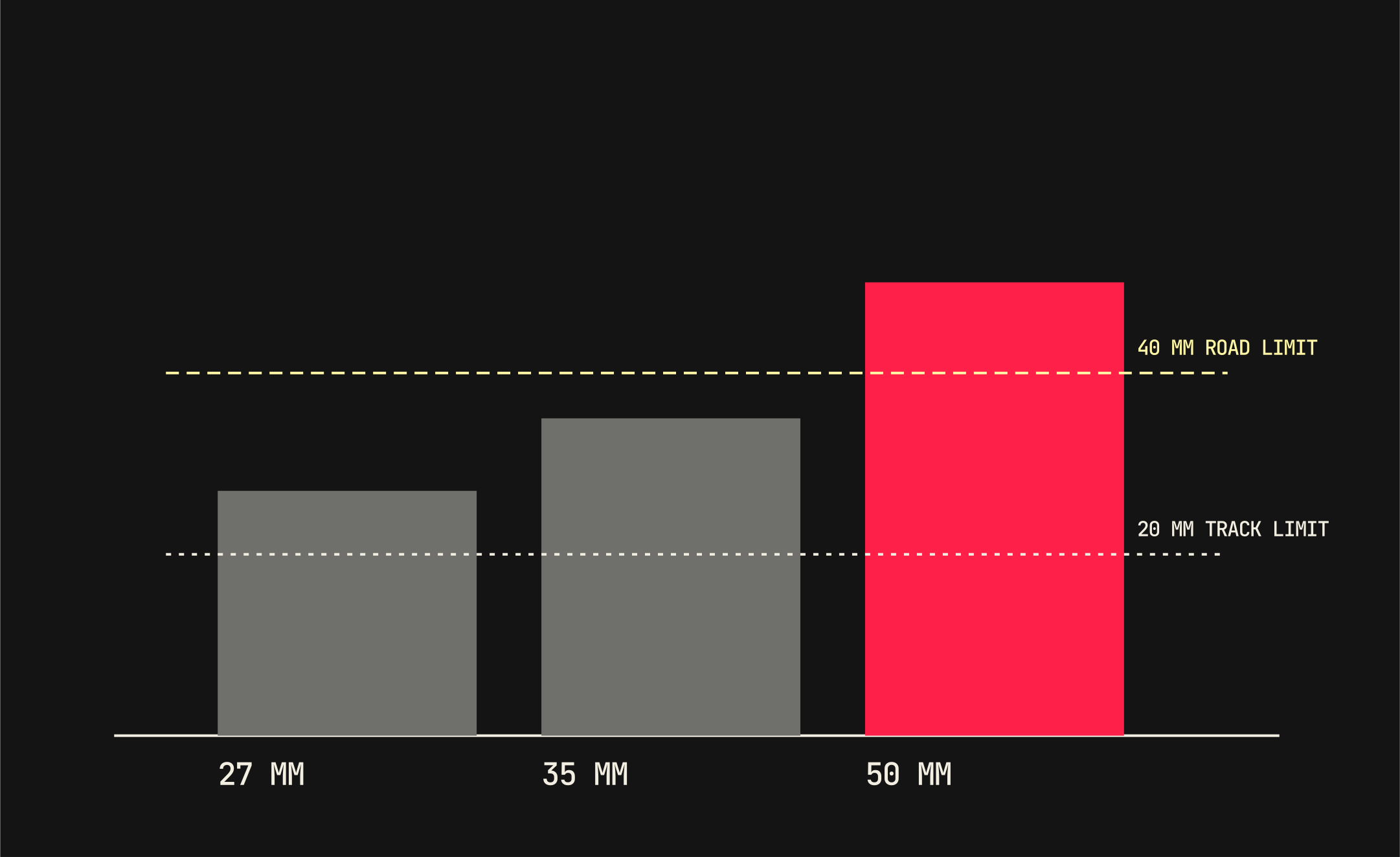
Soft foam lets designers build higher stacks without adding weight. A taller sole raises the foot further above the ground, which makes it easier for the heel to tip sideways on uneven ground.
World Athletics caps sole thickness at 40 mm for road racing shoes and 20 mm for track spikes, measured at the heel and forefoot. A 2023 review of the regulation found that a 20 mm change in stack height could be enough to change running economy and performance (Ruiz-Alias et al., 2023). The review does not address stability, and direct evidence on stability in very high stacks is still limited and mostly comes from small lab studies.
Many training shoes now go above 40 mm. That is allowed outside elite competition, but it is a reason to give tall soles a wider base and a firmer rim.
Super-foams lose their edge faster
In a 2024 study, 22 male runners were tested at 13 km/h in a PEBA racing shoe and an EVA shoe, both new and after 450 km of use. The PEBA shoe's energy cost rose by 0.32 ± 0.38 W/kg, while the EVA shoe's rose by only 0.06 ± 0.58 W/kg. After 450 km, the two shoes gave similar running economy (Rodrigo-Carranza et al., 2024).
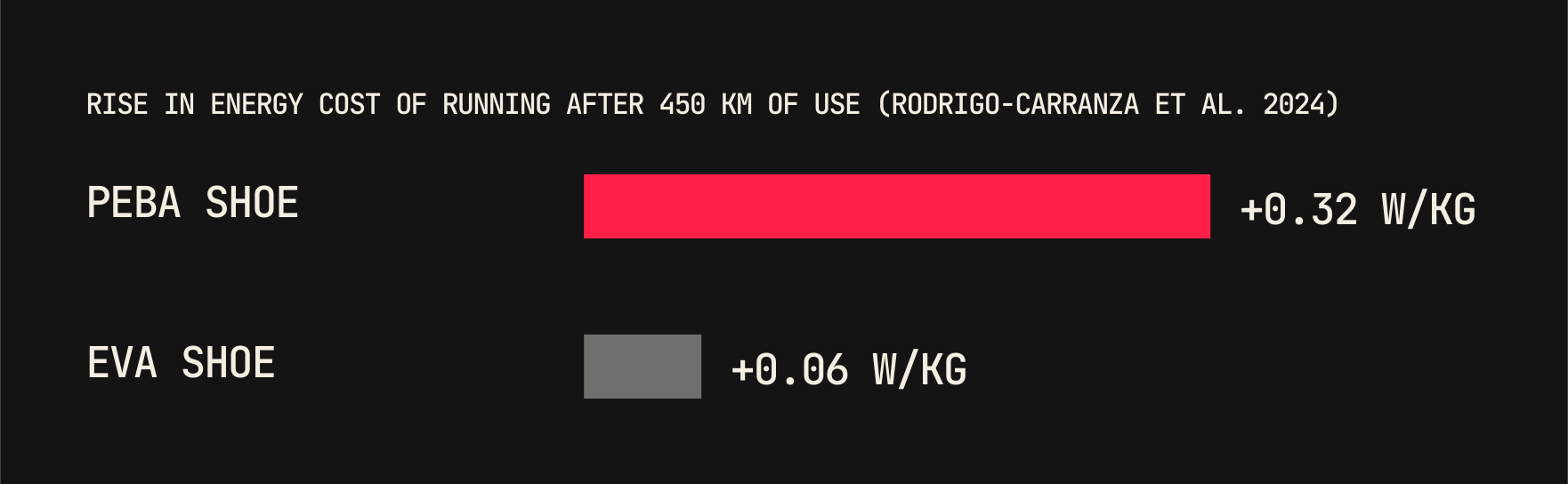
In other words, much of the super-foam advantage was gone by the time the shoe was well worn. The spread between runners was large, so not every runner lost the same amount.
What we take from it
- Test foams in shear as well as compression. Lateral behaviour is part of the specification.
- Combine materials. A resilient core with a firmer carrier and rim gives energy return without a wobbly platform.
- Widen the base as the stack goes up.
- Test after use, not only when new. Report performance after a defined distance, for example 450 km.
ALCMY Systems engineers midsoles and outsoles from the research up. Talk to us about your next sole.
Sources
- McCulloch, Delp & Kuhl 2026, arXiv preprint
- Ruiz-Alias et al. 2023, A review of the potential effects of the World Athletics stack height regulation on the footwear function and running performance, Applied Sciences 13:11721
- Rodrigo-Carranza et al. 2024, Scandinavian Journal of Medicine & Science in Sports 34