Every performance shoe now quotes an energy return figure. Some say 70%, some say 90%. The numbers are real, but they are not what most people think they are.
What energy return measures
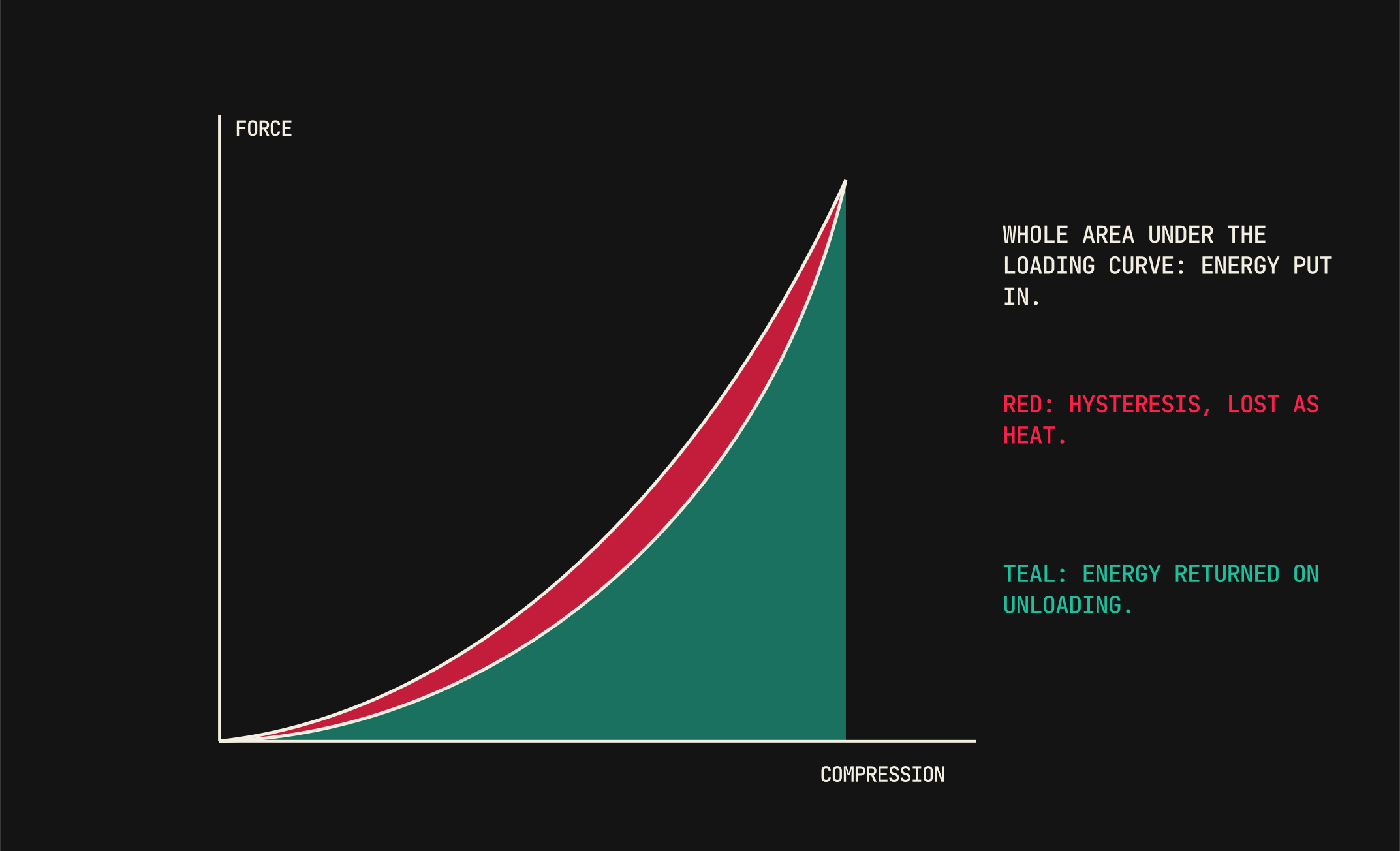
Press a foam down and let it go. If you plot force against compression, the loading curve and the unloading curve form a loop. The area under the loading curve is the energy you put in. The area under the unloading curve is the energy that comes back. The gap between them is lost as heat, which is called hysteresis.
Energy return is simply the second area divided by the first.
How the main foam families compare
The best single comparison comes from a 2018 study of three marathon shoes, loaded by a machine with a running-like force profile. The PEBA-foam Nike prototype returned 87.0% of the energy, the E-TPU adidas Adios Boost 2 returned 75.9%, and the EVA-based Nike Zoom Streak 6 returned 65.5% (Hoogkamer et al., 2018).
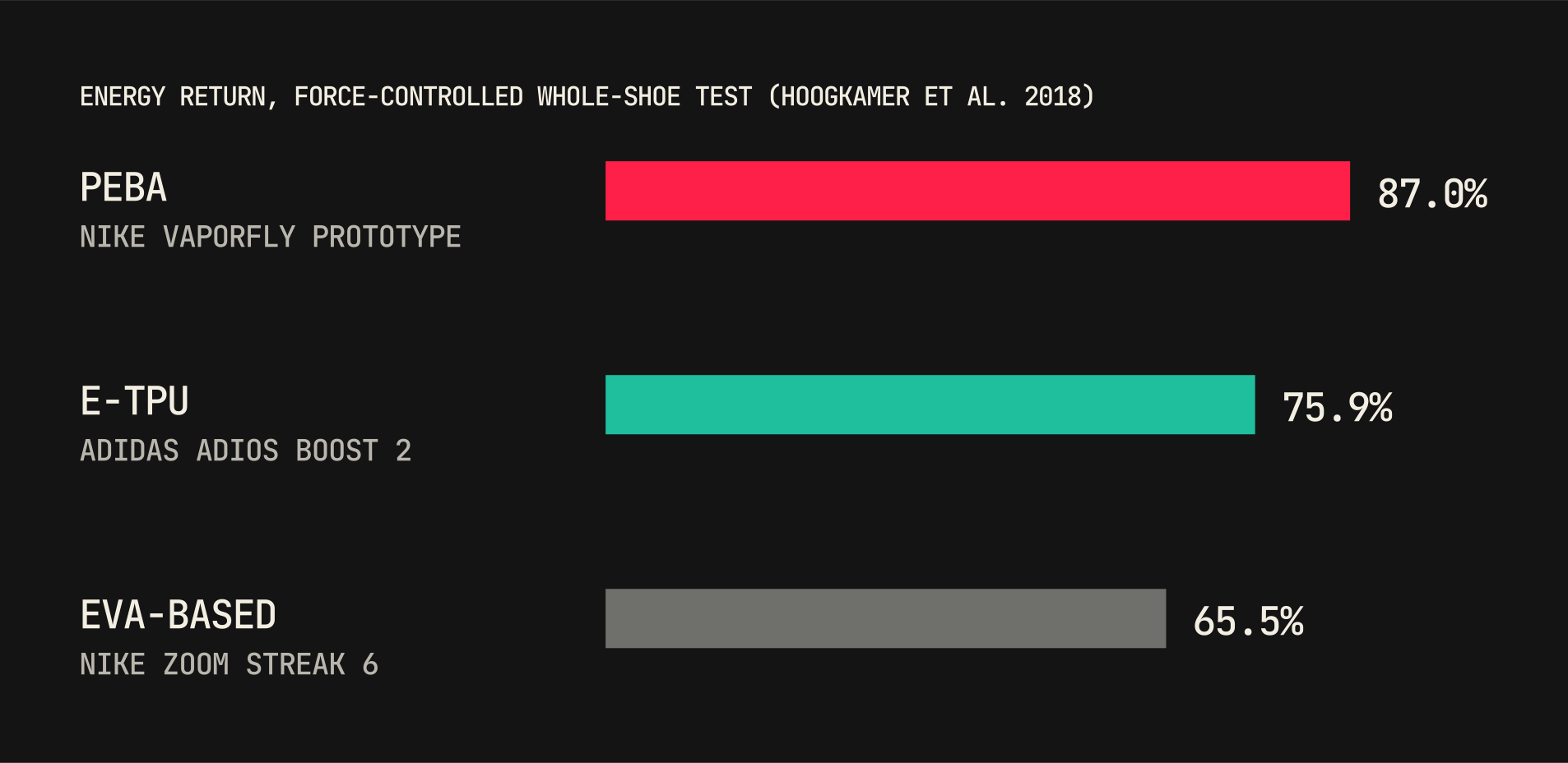
The PEBA shoe was also far softer: it compressed 11.9 mm against 6.1 and 5.9 mm for the other two. A softer foam that also wastes less energy stores and returns much more of it in absolute terms. That combination, not the percentage alone, is what makes a foam feel lively.
Why the same foam gets different numbers
Energy return is not a fixed property of a material. It depends on how hard, how fast and in which direction the foam is loaded (Shorten, 2024).
- Test type. A ball-rebound test, which drops a small steel ball on a foam slab, gives far lower values than a loading loop on the same material.
- Speed. A 2026 whole-shoe study at 1.5 to 2.5 loading cycles per second found stiffness rose and energy return fell slightly as frequency increased, more for EVA than for PEBA (Scherrer et al., 2026).
- Direction. Foam samples cut from ASICS racing shoes returned 85 to 90% of the energy when compressed, but only about 74 to 76% when sheared sideways. This result comes from a preprint that has not yet been peer-reviewed (McCulloch, Delp & Kuhl, 2026).
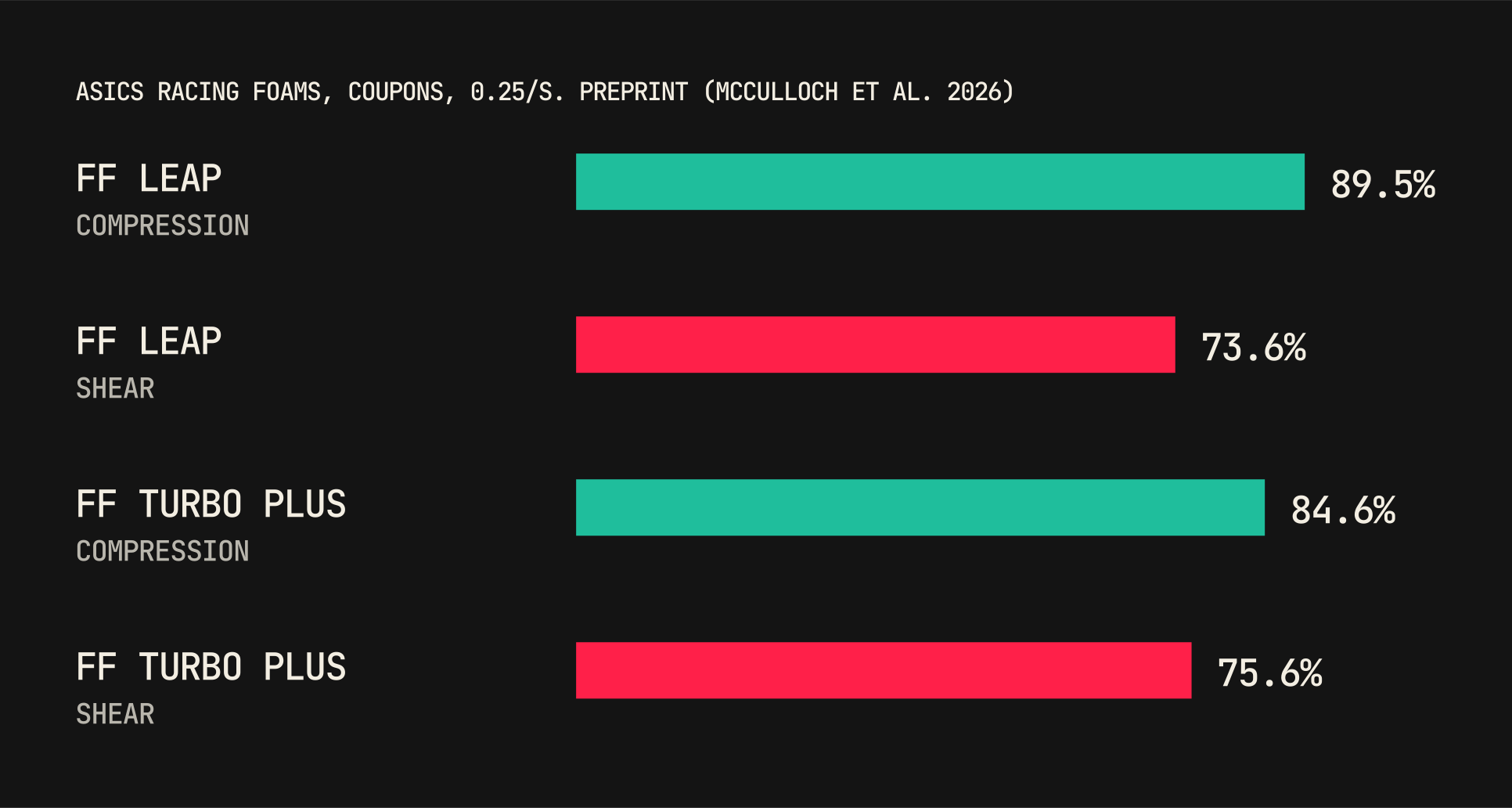
So a 55% figure and an 85% figure for the same family of foam can both be correct. They just answer different questions.
What we take from it
- Compare foams only within one test method. A percentage without its method, load, speed and temperature cannot be compared with anything.
- Look at energy in joules as well as percent. Softness, resilience and thickness together decide how much energy a midsole actually gives back.
- Test the way the foot loads. Running-like forces of 1500 to 2000 N, at running frequencies, and in shear as well as compression.
At ALCMY we rank every midsole compound on one in-house protocol, so a number on our material sheets means the same thing every time.
ALCMY Systems engineers midsoles and outsoles from the research up. Talk to us about your next sole.