Winter boots are sold on their lugs. On ice, the lugs are close to irrelevant.
Two thirds fail
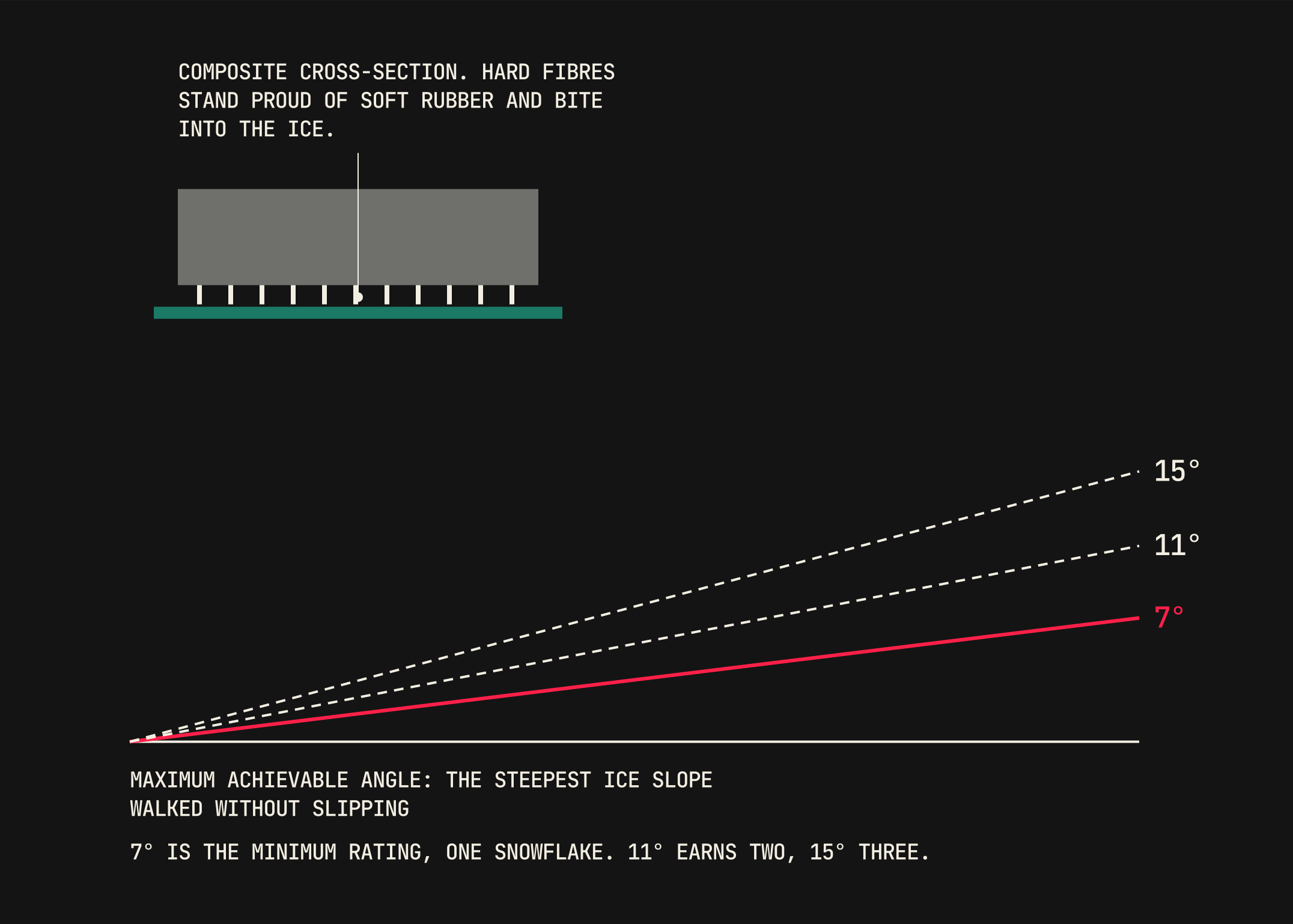
The KITE Research Institute in Toronto tests winter footwear the direct way. People walk up and down a slope of real ice while the angle increases. The steepest angle they manage without slipping is the score. Seven degrees earns the minimum rating, one snowflake; 11 and 15 degrees earn two and three.
About 67 percent of the footwear tested through the Rate My Treads programme does not reach seven degrees.
What the pattern does
In 2023 the same researchers built 27 outsole prototypes around a fibre-composite rubber and varied four things: tread depth, tread shape, tread orientation and the area covered by the composite (Islam et al., 2023).
Only one factor reached statistical significance: composite area. Depth, shape and orientation did not.
The best prototype was not the most aggressive one. It was the one that put the most composite on the ice, as round and half-round plugs laid in oblique rows, mostly under the forefoot.
Why
Ice near freezing carries a thin liquid-like layer, and rubber alone finds little to hold. Composite outsoles work differently: hard fibres or particles stand slightly proud of soft rubber and bite into the surface. That is material doing the work, not geometry.
The effect holds outside the lab. In an eight-week winter field study of home-care workers, composite outsoles cut slips by 68 percent and falls by 78.5 percent against a control group.
Three cautions
- Grip wears off. Ice performance of composite soles dropped measurably after 75,000 steps of wear.
- Temperature changes the ranking. A compound that leads at minus ten can trail near zero. Test at both.
- Ice is not snow. In soft snow and slush a sole grips by digging in, which is different physics. Published footwear data on snow is thin.
What we take from it
For an ice outsole, choose the compound first and let the pattern serve it: maximise composite contact, concentrate it in the forefoot, and treat the lugs as carriers. Then test on real ice, cold and wet.

ALCMY Systems engineers outsoles from the research up. Talk to us about your next sole.