Cushioning is sold as protection: softer foam, less impact, fewer injuries. Two studies show the first and last parts can be true while the middle part is wrong.
Softer shoes did lower injury risk
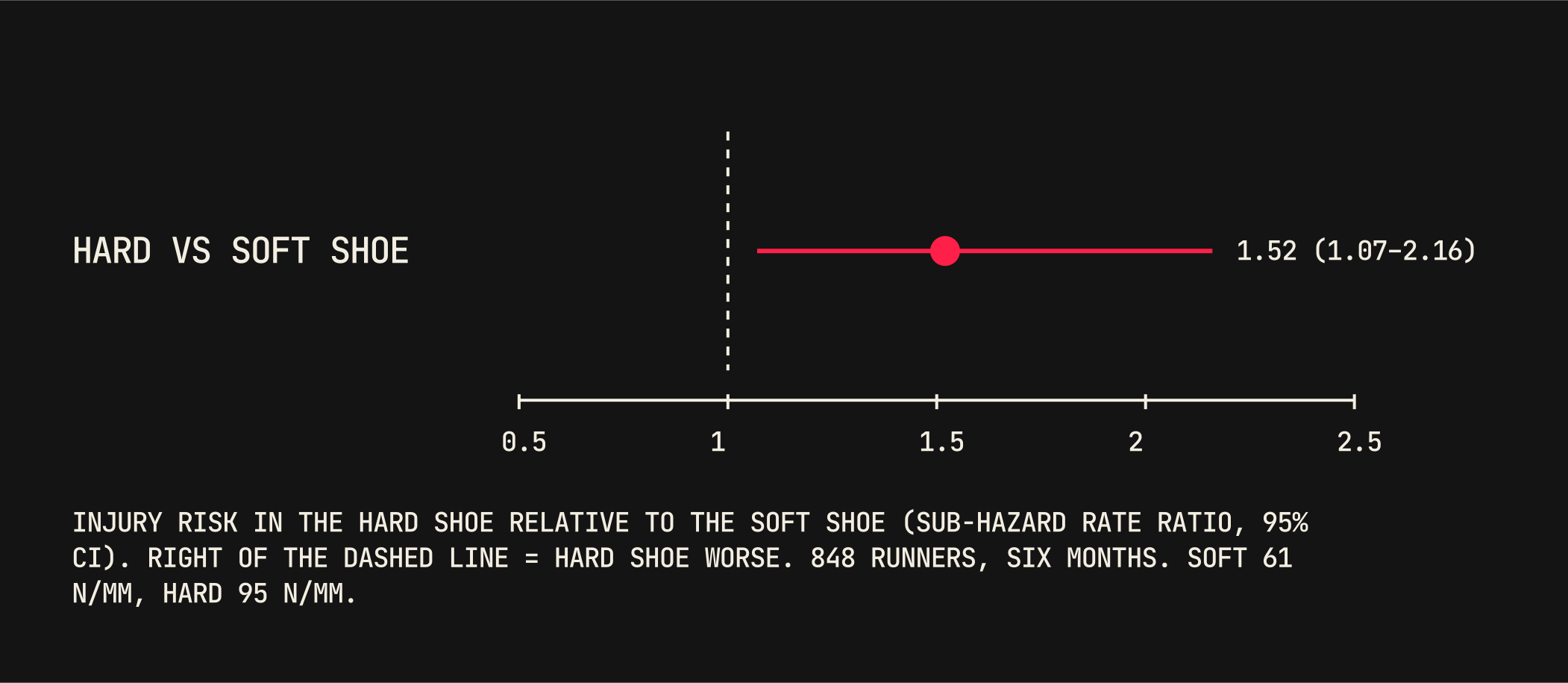
The Luxembourg Institute of Health gave 848 recreational runners one of two prototype shoes that differed only in cushioning. The soft version had a whole-shoe stiffness of 61.3 N/mm, the hard version 94.9 N/mm (Malisoux et al., 2020). Runners were followed for six months.
Runners in the hard shoe had a higher injury risk, with a sub-hazard rate ratio of 1.52 (95% CI 1.07 to 2.16). Body mass on its own was not linked to injury risk. But, as the paper's title says, the effect of cushioning depended on body mass: the protective effect was found in lighter runners.
But not by lowering impact
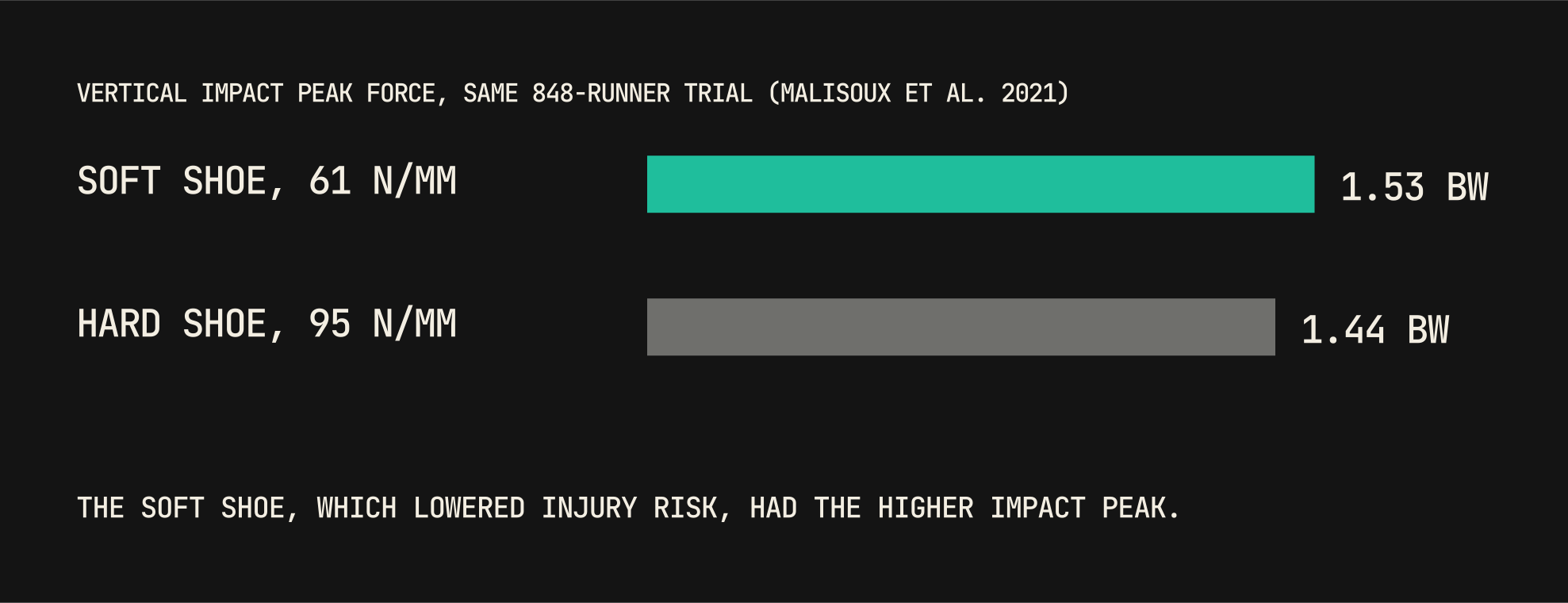
In the same group of runners, the soft shoe produced a higher vertical impact peak, 1.53 against 1.44 times body weight. The loading rate did not differ significantly (Malisoux et al., 2021). The authors conclude that the benefit of cushioning on injury risk cannot be explained by lower impact forces.
Thicker foam can even raise impact
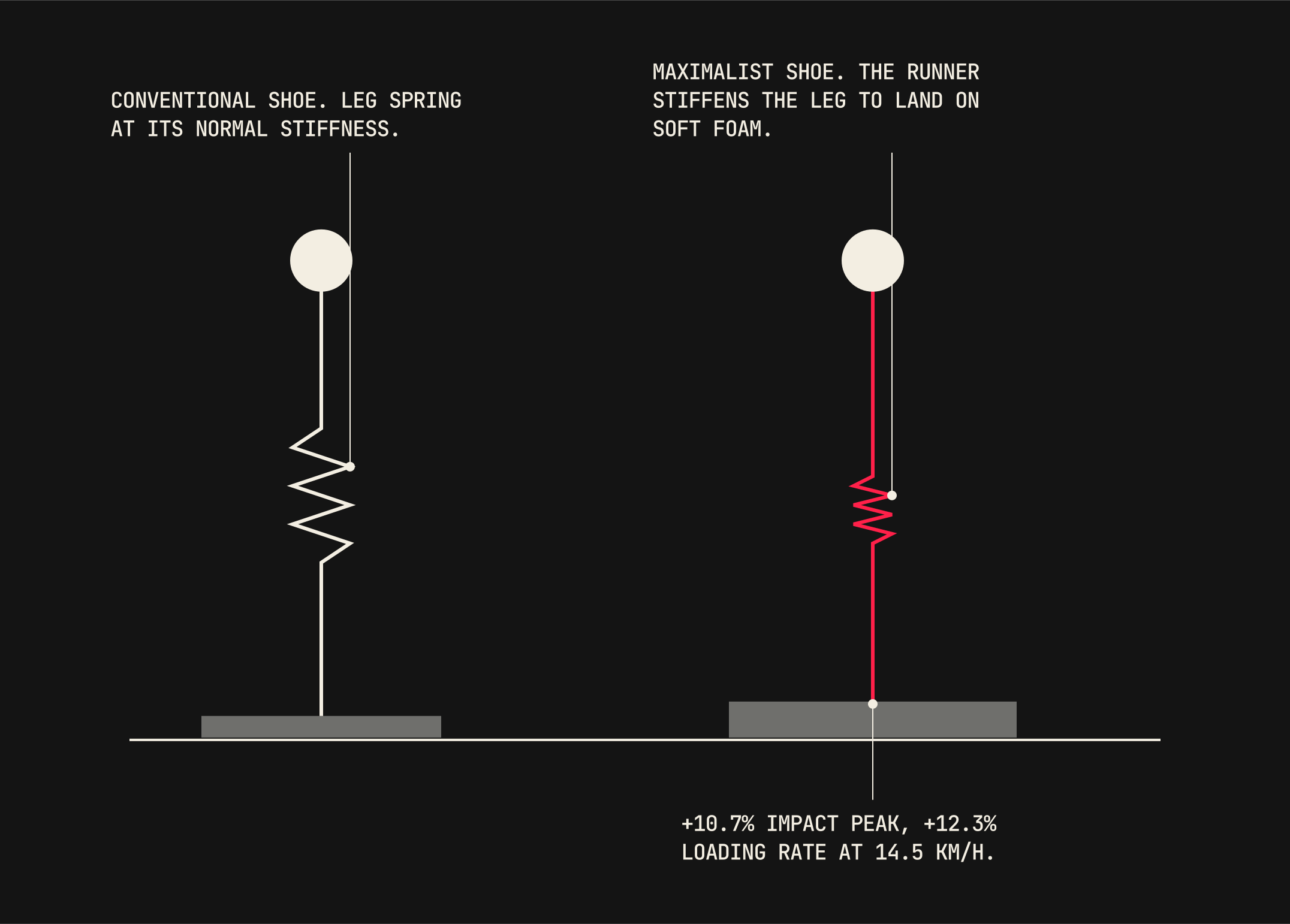
At the University of Jyväskylä in Finland, runners compared a highly cushioned maximalist shoe with a conventional one. At 14.5 km/h, the maximalist shoe raised the impact peak by 10.7% and the loading rate by 12.3%. At 10 km/h the impact peak was 6.4% higher (Kulmala et al., 2018).
The explanation is the body itself. Runners land on a soft surface with a stiffer leg, so the impact is not absorbed but changed. The researchers suggest this may explain why more cushioning has not reduced impact-related running injuries.
What this means
Impact peaks measured in a lab, by a machine or on a force plate, are not a good stand-in for injury protection. Something about softer shoes helps some runners, but it is not simply "less shock".
What we take from it
- Don't sell lower impact as injury protection. The evidence does not support it.
- Offer cushioning by runner. The one large trial points to soft shoes for lighter runners, and firmer, wider platforms for heavier ones.
- Measure people, not just foam. Comfort, loading and injury outcomes in real runners are what count.
ALCMY Systems engineers midsoles and outsoles from the research up. Talk to us about your next sole.
Sources
- Malisoux et al. 2020, Shoe cushioning influences the running injury risk according to body mass, American Journal of Sports Medicine 48
- Malisoux et al. 2021, European Journal of Sport Science
- Kulmala et al. 2018, Running in highly cushioned shoes increases leg stiffness and amplifies impact loading, Scientific Reports 8