A slip-resistant shoe does not lose its grip gradually. It holds, then it lets go, and the point where it lets go can be measured.
Tread is a drainage system
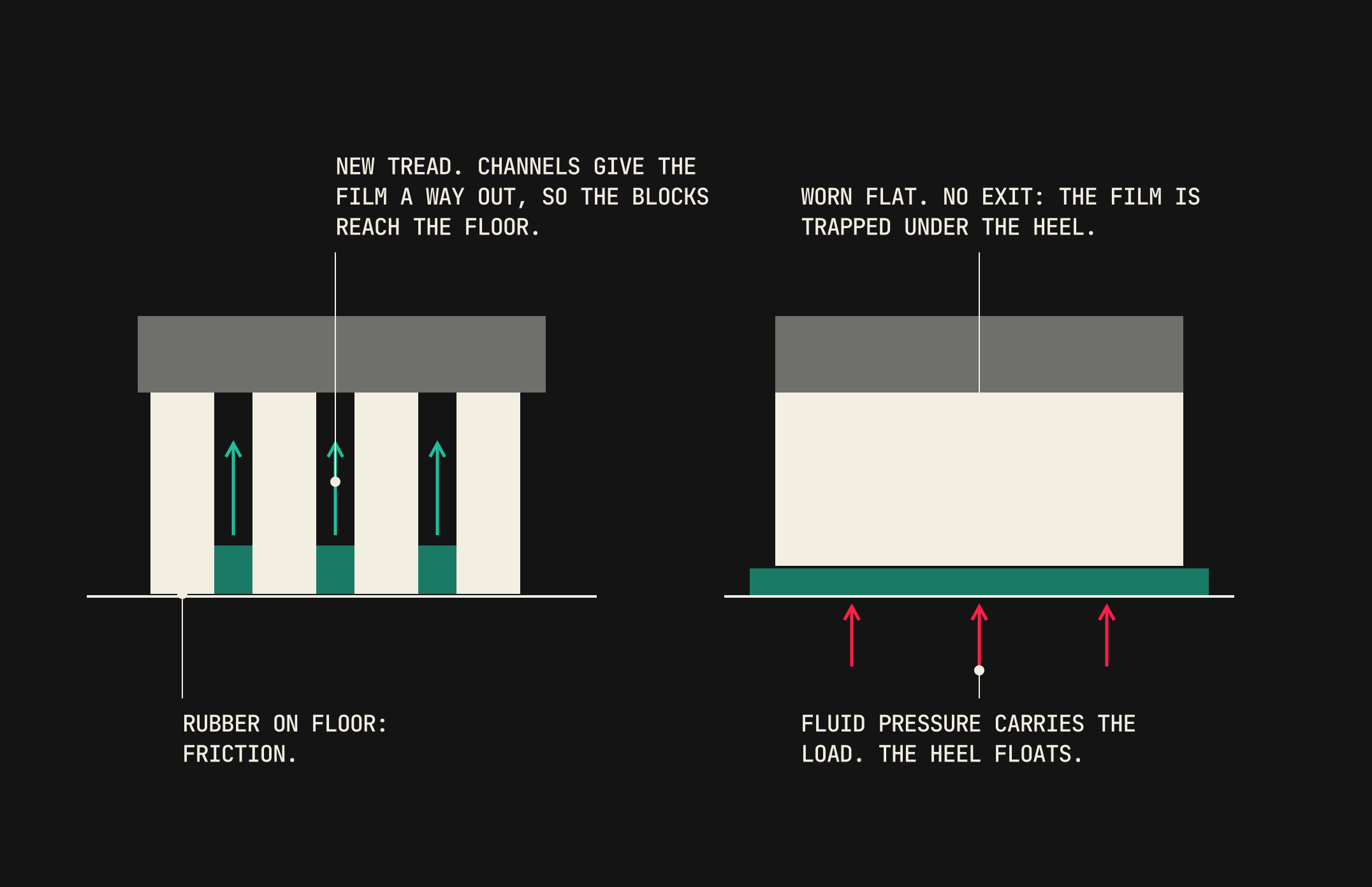
On a wet floor, the liquid film is the problem. Rubber grips when it touches the floor and slides when it rides on fluid. The channels between tread blocks give that fluid somewhere to go.
When the blocks wear down to the depth of the channels, the exit closes. Fluid is trapped under the heel, pressure builds, and the shoe floats. The University of Pittsburgh group that studies this links slip risk to an under-shoe fluid force above about 25 N, roughly a tenth of the load on the heel.
The number
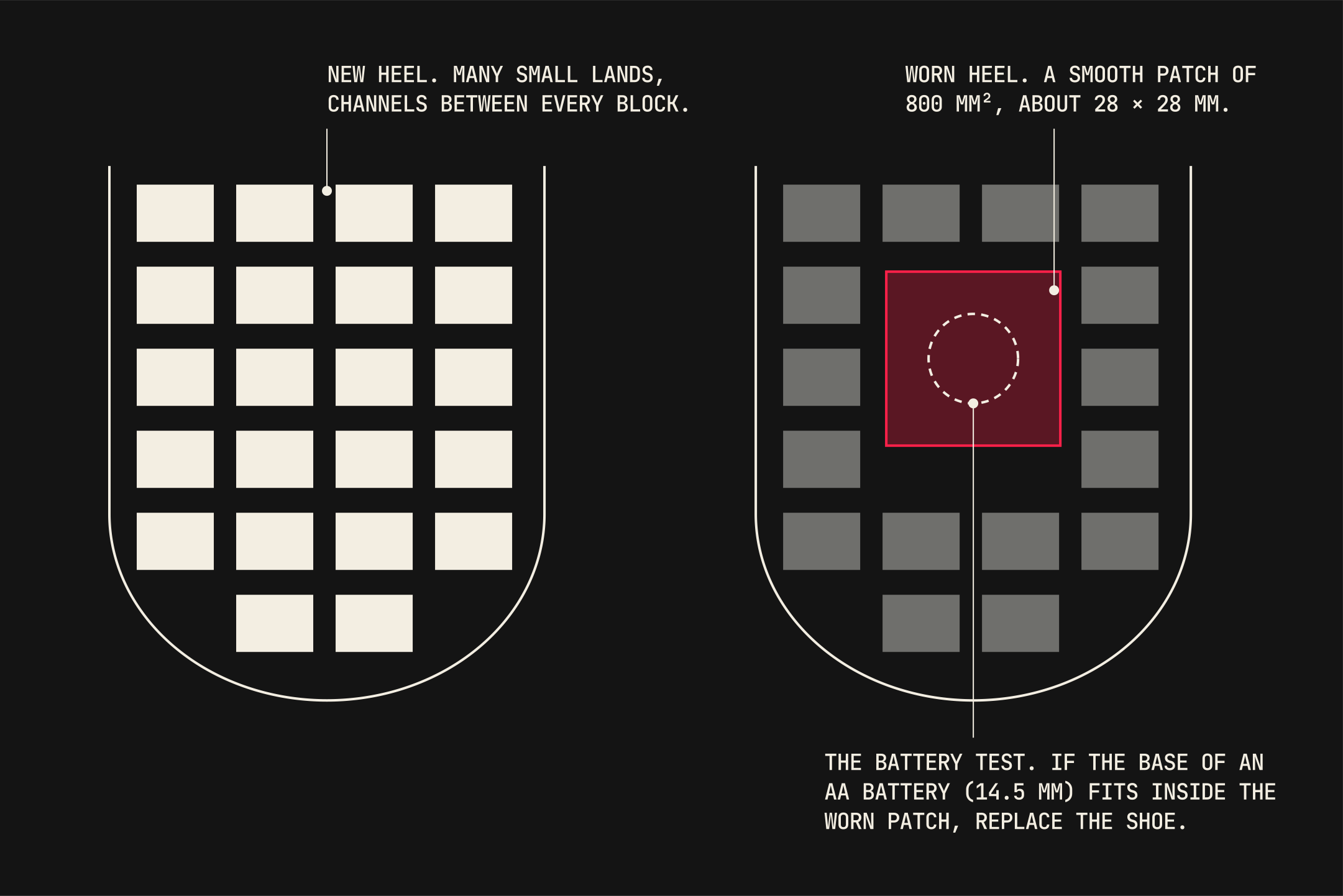
Researchers at the University of Pittsburgh abraded slip-resistant shoes step by step and measured friction and under-shoe fluid pressure after each stage. Friction held, and even rose slightly, in early wear. It then fell once the smooth region in the heel grew past about 800 mm² (Hemler et al., 2019).
That is a patch of roughly 28 by 28 millimetres.
A follow-up with naturally worn shoes put figures on it. At an 800 mm² worn region, friction was 16 to 38 percent lower and the force carried by the fluid was 286 to 528 percent higher (Hemler et al., 2022). In a trial with 57 people on an unexpected slippery surface, larger worn regions meant more slips (Sundaram et al., 2020).
The same group turned this into a field check: if the base of an AA battery fits inside the worn patch, replace the shoe.
What it means for design
Most brands treat this as a replacement guideline for the wearer. We read it as a design brief.
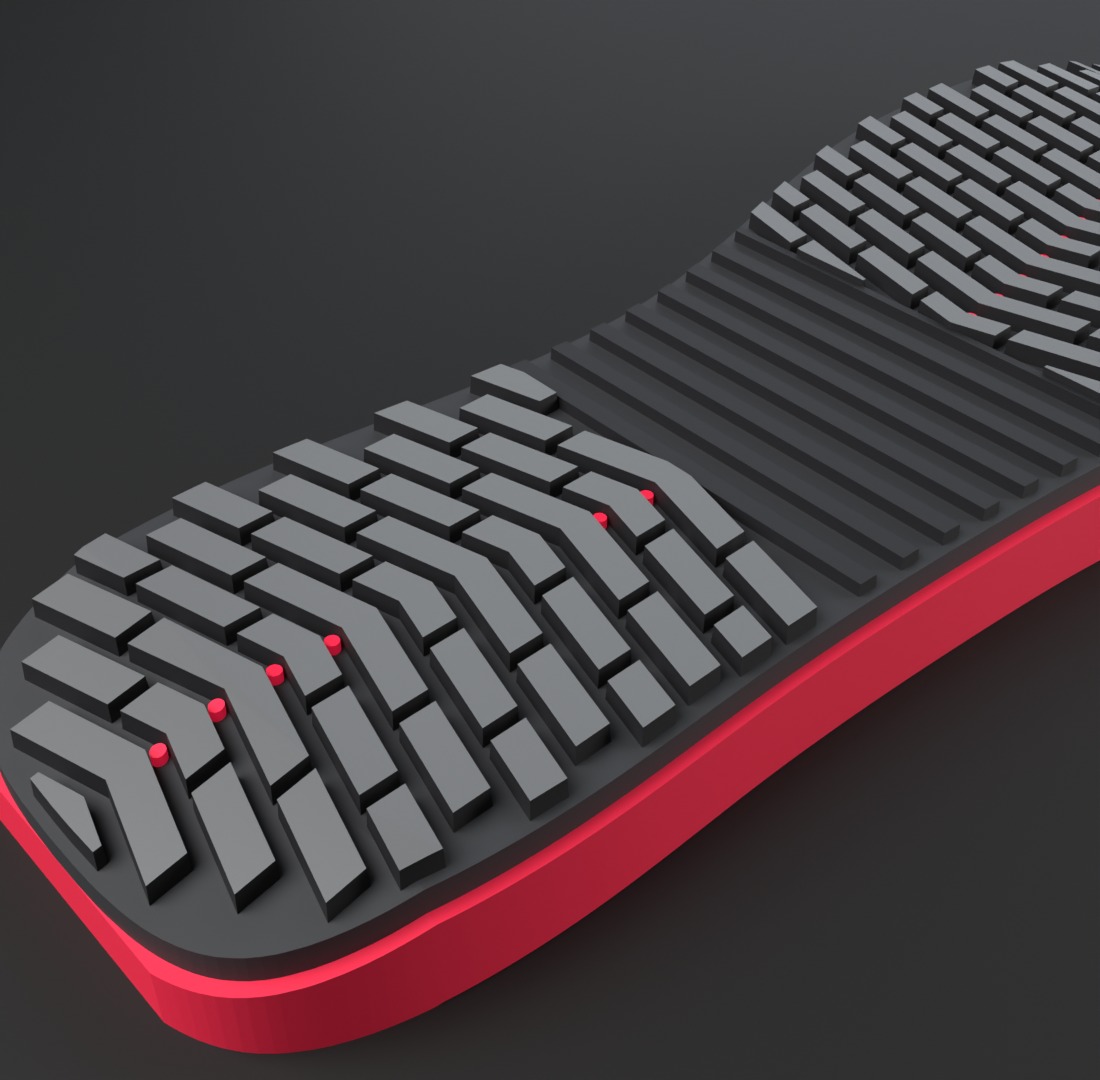
- Split the heel into small lands. If no single block is large, no worn patch can merge into one large smooth zone quickly.
- Carry channels to full depth where pressure is highest. Those are the areas most likely to wear first.
- Mould wear indicators into the channels. A contrast-colour pad at replacement depth tells the wearer what the battery test would.
- Test worn, not only new. A certificate describes the shoe on day one. The wearer needs it on day two hundred.
A sole that passes a slip test when new and fails after six months of wear has met the standard and missed the point.
ALCMY Systems engineers outsoles from the research up. Talk to us about your next sole.
Sources
- Hemler et al. 2019, Changes in under-shoe traction and fluid drainage for progressively worn shoe tread, Applied Ergonomics
- Hemler et al. 2022, Effects of natural shoe wear on traction performance, Footwear Science
- Sundaram et al. 2020, Worn region size of shoe outsole impacts human slips, Journal of Biomechanics